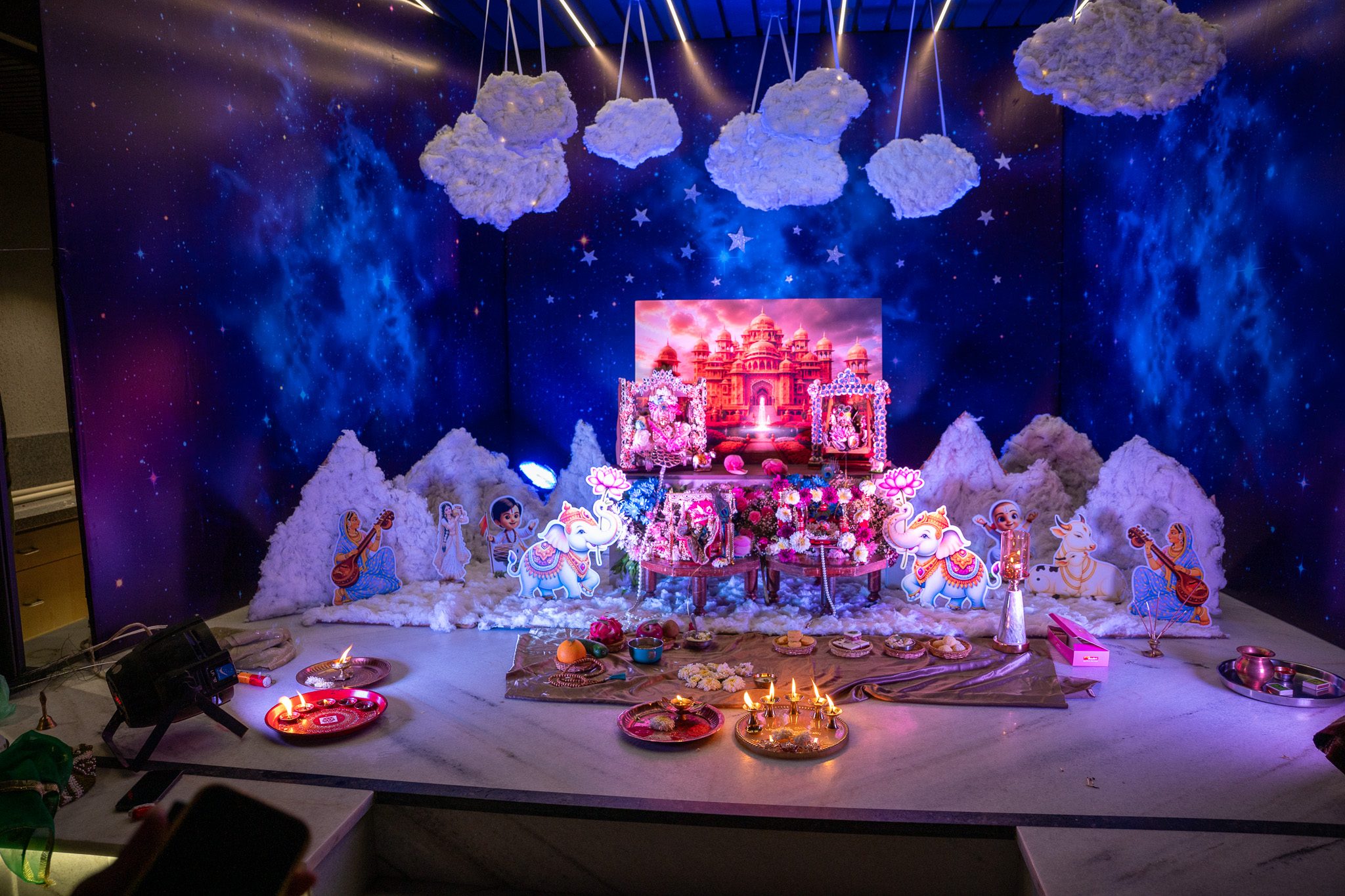
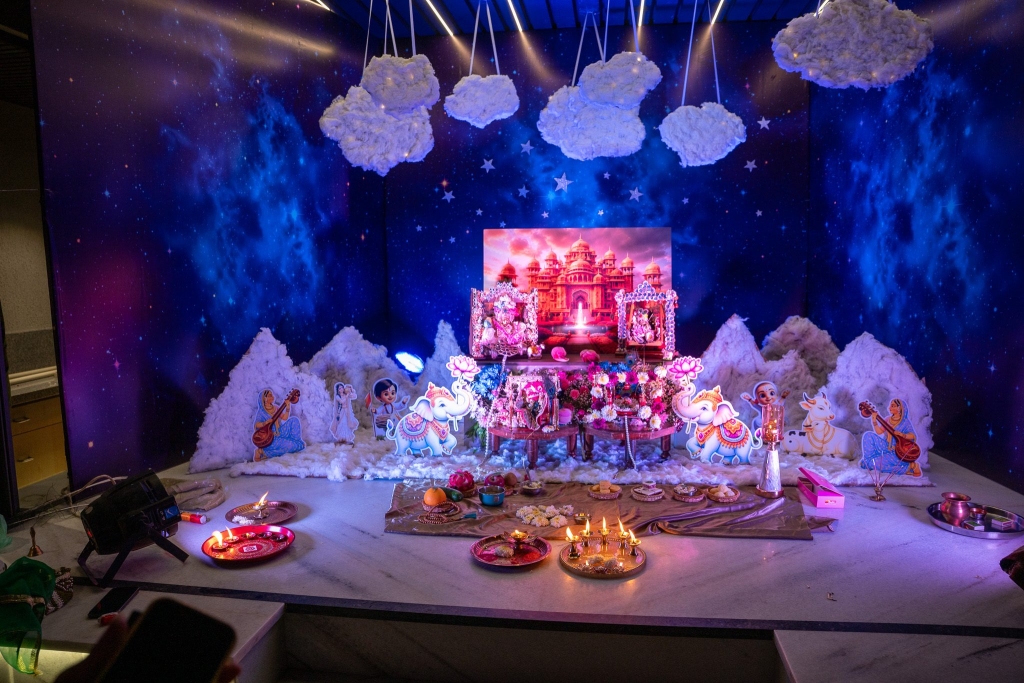
Our terrace turned into a small piece of Vrindavan this year. Diyas lined the mosaic floor, a hand-built mountain of clouds hung overhead, and somewhere between the aarti thali and the sound of the conch shell, three generations of our family stood barefoot on the grass, waiting for midnight. This is what Janmashtami looks like at our home – not a quiet ritual tucked into a corner, but the whole family, from the youngest toddler on a shoulder to the eldest aunt with a diya in her hand, showing up together.
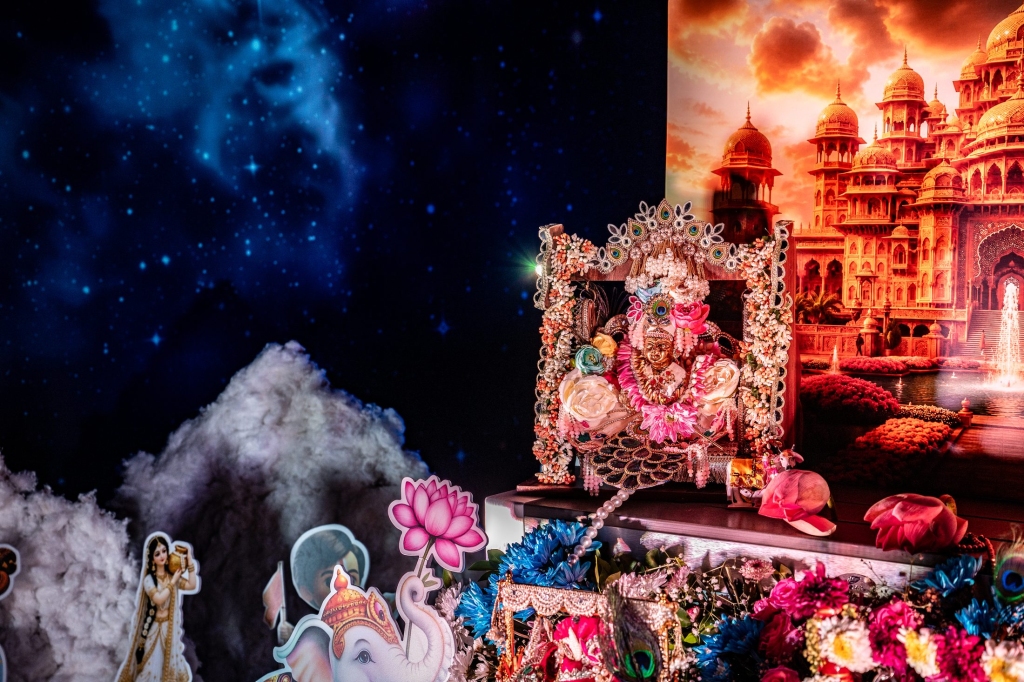
This year’s setup was more elaborate than usual – a night sky of stars and hand-stitched clouds, cotton-wool mountains standing in for Govardhan, cutouts of gopis and elephants flanking a beautifully dressed Laddu Gopal seated on a jhula, with a glowing pink palace of Vrindavan in the backdrop. Every flower, every fairy light, every peacock feather was placed with the kind of care that only comes from doing this together, year after year, as a family.
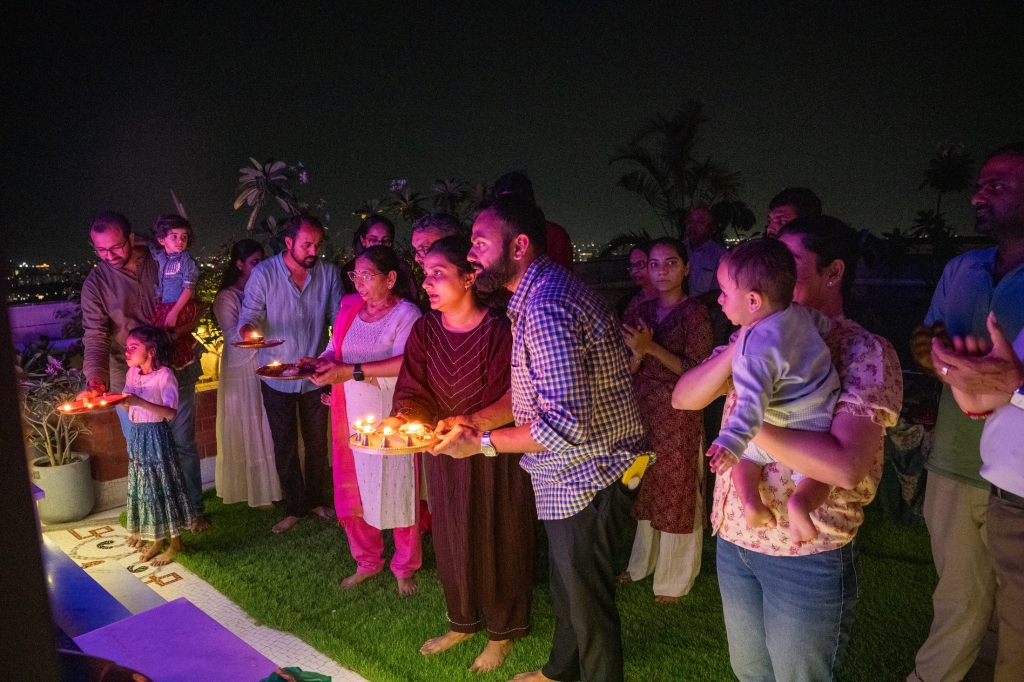
Later that night, we moved up to the terrace for the aarti. Diyas were lit and passed from hand to hand, the youngest kids peering over shoulders to catch a glimpse of the flame, the elders singing the bhajans they’ve known since they were children themselves. There’s something about standing under an open sky with your whole family, thali in hand, that no indoor puja room can quite replicate. It’s less about the ritual being perfect and more about everyone being present for it – together, barefoot, unhurried.
We put together a short video around this Janmashtami, sitting with the same question we ask ourselves every year while we’re decorating the jhula and stringing up the lights: what does Krishna actually mean to us, beyond the festival? The more we talked about it, the clearer it became that Krishna isn’t only a God we pray to once a year and put back on the shelf. He’s closer than that – a way of looking at very ordinary problems: fear, loss, love, duty, letting go. Here’s what stood out to us this year.
Krishna was born on the darkest night of the year, inside a prison cell in Mathura, to parents, Devaki and Vasudev, who were locked away specifically to stop this birth from happening. There was no palace, no celebration, no safety – just a storm outside and a newborn who had to be smuggled out in secret before sunrise. It’s a reminder that hope doesn’t wait for the light. Sometimes it’s born right in the middle of the dark, when things look the most hopeless, and that’s exactly when it matters most.
The story goes that Vasudev then had to carry the infant Krishna out of the prison and across a flooded Yamuna in the middle of that same stormy night, on foot, alone, with the river rising around him. He had every reason to be afraid – and he was still afraid – but he didn’t let the fear stop him from doing what needed to be done. That’s the part we come back to every year: courage was never about not being scared. It’s about carrying your responsibility anyway, one step into the water at a time.
Then there’s the Krishna of Gokul – the butter thief, the prankster, the one who turned mischief into an art form and got the whole village laughing along with him. It’s easy to treat devotion as something serious and solemn, but Krishna’s childhood is basically an argument against that. He danced, he stole, he played the flute till the cows stopped grazing to listen, and he made joy look effortless. The lesson we keep taking from it: living seriously isn’t the same as living fully. There’s room for laughter even in the middle of your responsibilities.
Radha and Krishna’s love is remembered as the purest kind precisely because it was never about ownership. Krishna eventually left Vrindavan for Mathura and Radha never went with him, yet their bond is still held up as the ideal of love, centuries later. There’s something in that worth sitting with – real love isn’t about holding on tighter. Sometimes it’s about giving the people you love the freedom to be who they are, and to go where they need to go, without that freedom being mistaken for a lack of love.
Years later, on the battlefield of Kurukshetra, Krishna gave Arjun the advice that probably gets quoted more than anything else from his life: do your duty, and let go of your attachment to the result. Not because the outcome doesn’t matter, but because holding on to how things “should” turn out is what makes us hesitate, freeze, or act from fear instead of clarity. It’s a hard thing to actually practise – we still catch ourselves chasing outcomes more than we’d like to admit – but it’s the one lesson from Krishna’s life that shows up in the most unglamorous, everyday moments: work, parenting, relationships, decisions that don’t have a clean answer. Do the work in front of you. The result was never fully yours to control anyway.
None of this is new information, really – most of us grew up hearing these stories. But there’s a difference between knowing them and actually letting them sit with you while you’re stringing up fairy lights with your family at midnight. This Janmashtami, decorating the terrace, doing the aarti with three generations of our family standing together, and then sitting down to put these thoughts into words – it all felt like the same celebration, just in different forms. Krishna, for us, isn’t just a God we worship one night a year. He’s a feeling we try to carry through the rest of it.
Watch the full video and hear these reflections in more detail on our YouTube channel, Roads Rewritten with Alok – and tell us in the comments, which of Krishna’s stories means the most to you?